Lance Nabers, LPC · 25 years in practice

Your notes belong in your office.

For a hundred years they lived in a locked cabinet down the hall. Software moved them into a stranger's building and asked you to trust a contract. We moved them back.

Written by a therapist, for therapists. No technical knowledge needed to read this page.

The whole thing, in plain words

Why this is different, told slowly.

You do not need to understand computers to follow this. It is five steps, and each one is short.

  1. Every other system in this field keeps your notes on a company's computers. You type a session note, and it travels to a building you have never seen, owned by people you have never met. That is not a scandal — it is simply how nearly all of this software is built.
  2. When a company holds your clients' records, the law wants that company to sign something. It is a contract that makes them responsible for protecting what they are holding. In the trade it is called a Business Associate Agreement. Your clients' privacy rests on it.
  3. So we went to get one signed. And we found something. The company that hosts software like ours will only sign that contract on their expensive business plans — and they add roughly twenty percent to the bill for the privilege. The ordinary plan our product had been set up on could never be covered by that contract at all. Not for more money. Not by asking nicely. Ever.
  4. We stopped trying to buy the contract. We took the records off their computers entirely and put them on yours — the machine already sitting on your desk, in the office you lock at night.
  5. Now there is nothing to sign, because there is nobody to sign it with. No company is holding your clients' records, so no company needs to promise to look after them. The problem was not solved. It was removed.
This is the part I want you to hear: the safest place for a record is not a better vault somewhere else. It is no journey at all.
If you prefer a picture

Where the record goes.

Then — and still, in every good practice
Your officea locked cabinet ✓ it never leaves
Most software today
Your officeyou type the note it travels A company's buildingnow a contract must be signed
The Lighthouse
Your office. Full stop.the record never sets off ✓ nothing to sign
The part I am most sure of

A larger company cannot follow us here.

Not because they lack the talent. Because of what they are.

Their whole business is holding it

A company whose product is a place to keep your records has priced itself, staffed itself and promised its investors a future built on keeping them. Handing the records back to you removes the thing they sell.

Ours is handing it back

This was built by one clinician who wanted his own notes where he could see them. There are no investors to disappoint and no warehouse to justify. The small size is the whole advantage.

To do what we do, they would have to stop being what they are. That is not a feature anyone can copy in a quarter.
And this is the thing itself

The Lighthouse — an EHR that is pleasant at 8am.

Your client lives on the island. You get the lighthouse. It is a clinical workspace: your day, your notes, your assessments, your telehealth — wired to what your client actually did between Tuesday and Tuesday.

The task list writes itself from real events. Sign a note and its task resolves on its own. You never manage the list; it manages itself.
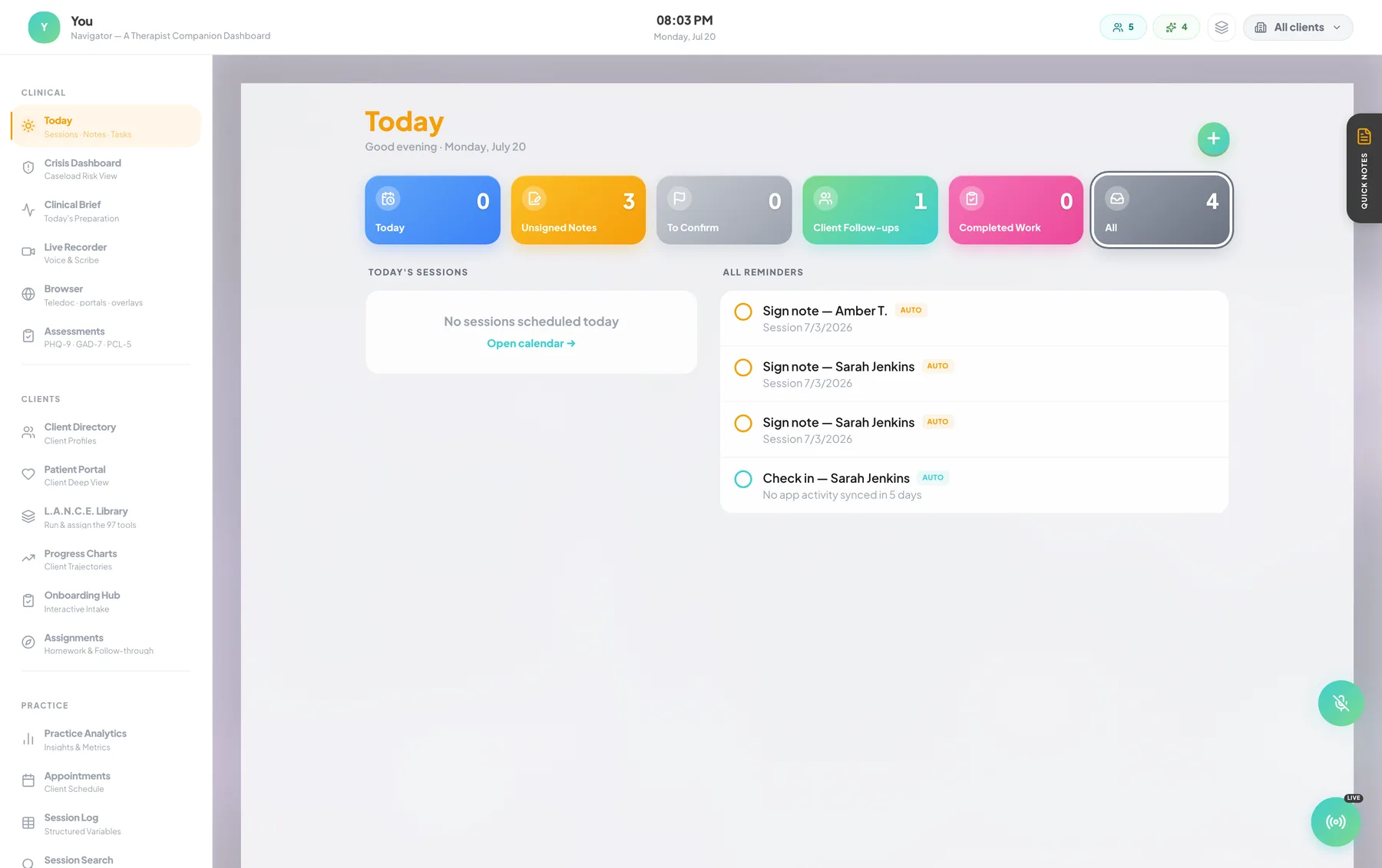
The Today screen: the day's sessions and the tasks that wrote themselves.
Today. The list is built from real events — not from you remembering to add things.
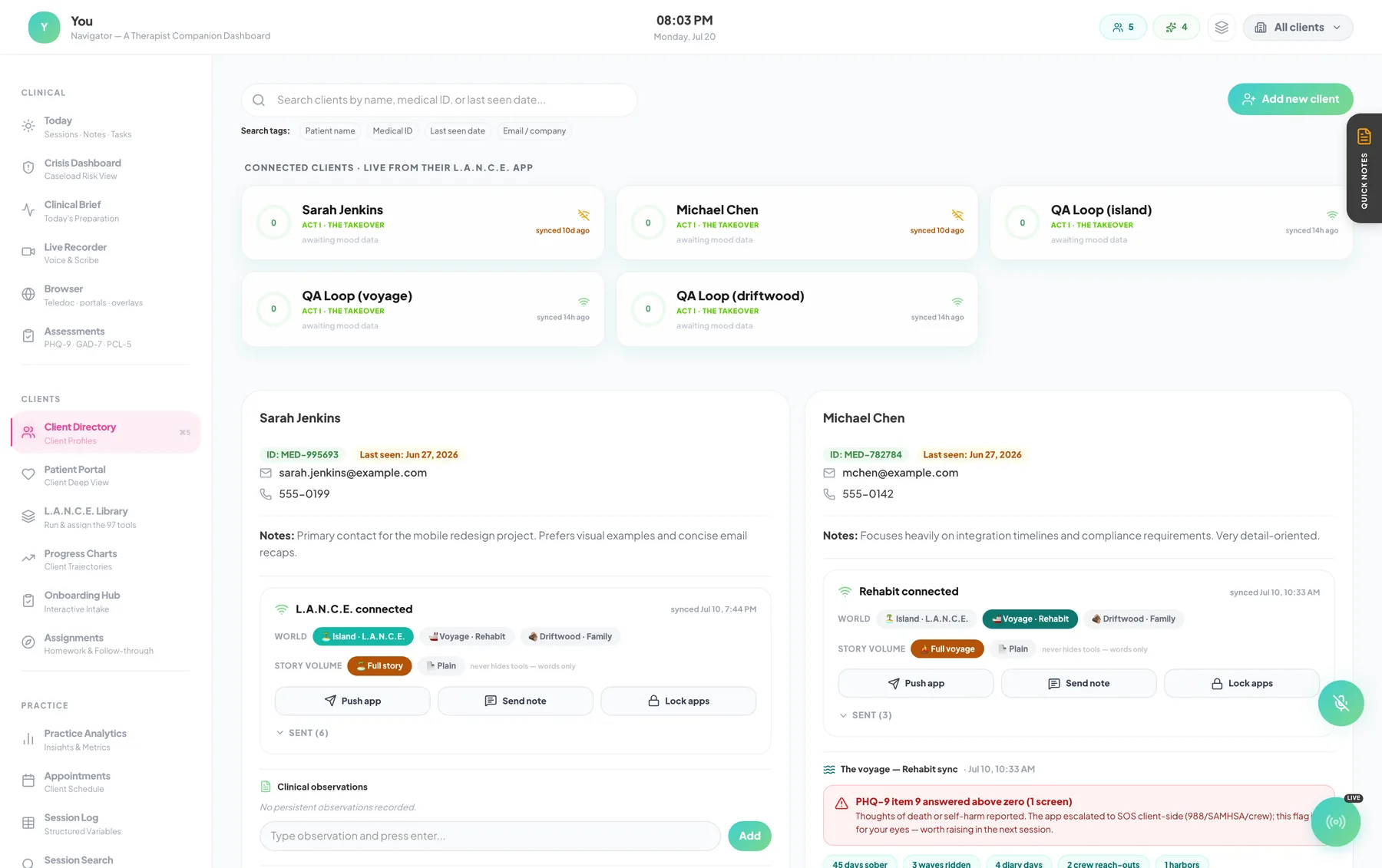
The Bridge: every paired client, their progress and recent mood.
The Bridge. Every paired client at a glance, and which part of the story they are in.
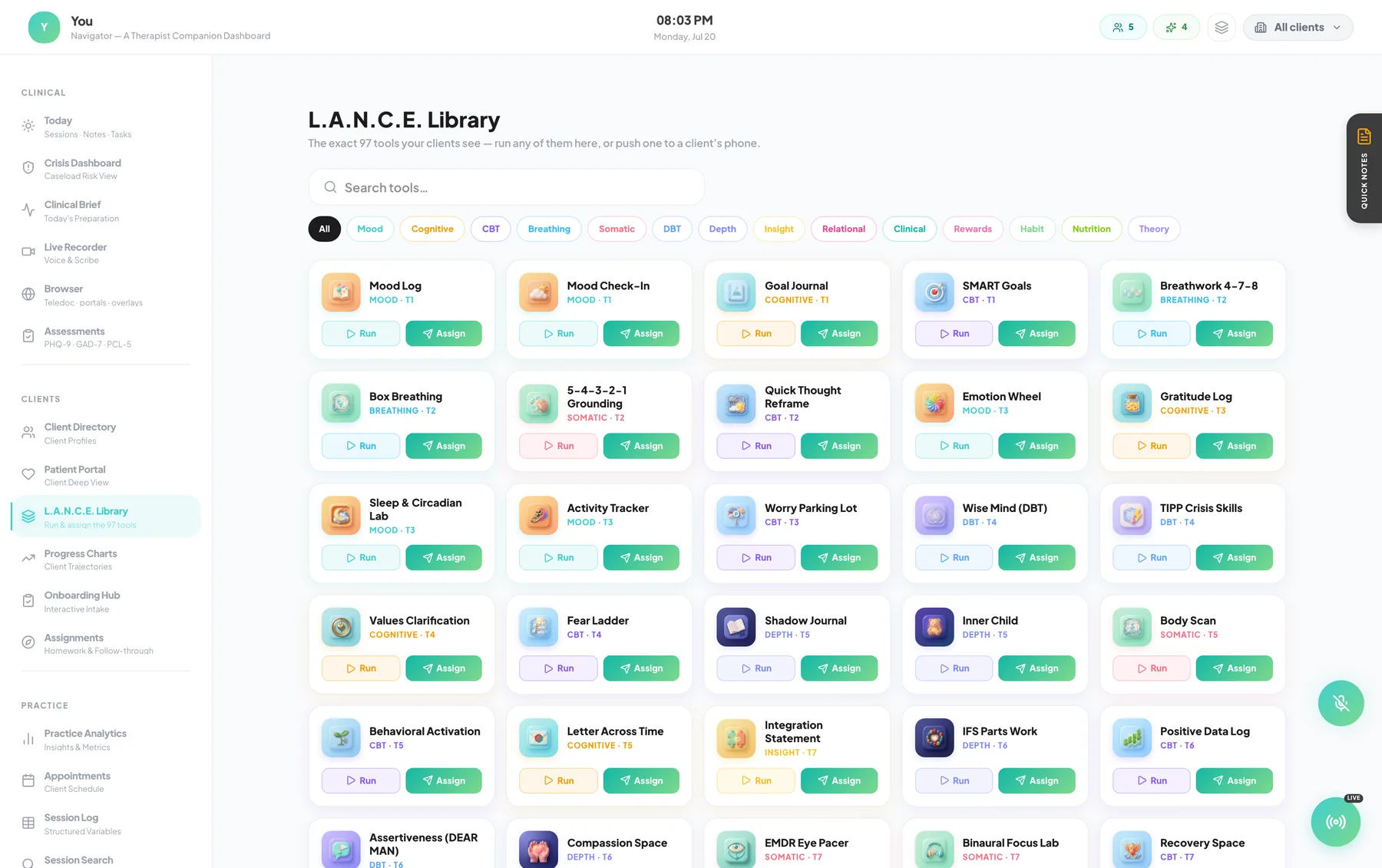
The library of 96 therapeutic tools, runnable inside the app.
The library — 96 tools you can demonstrate before you assign, or run together in session.
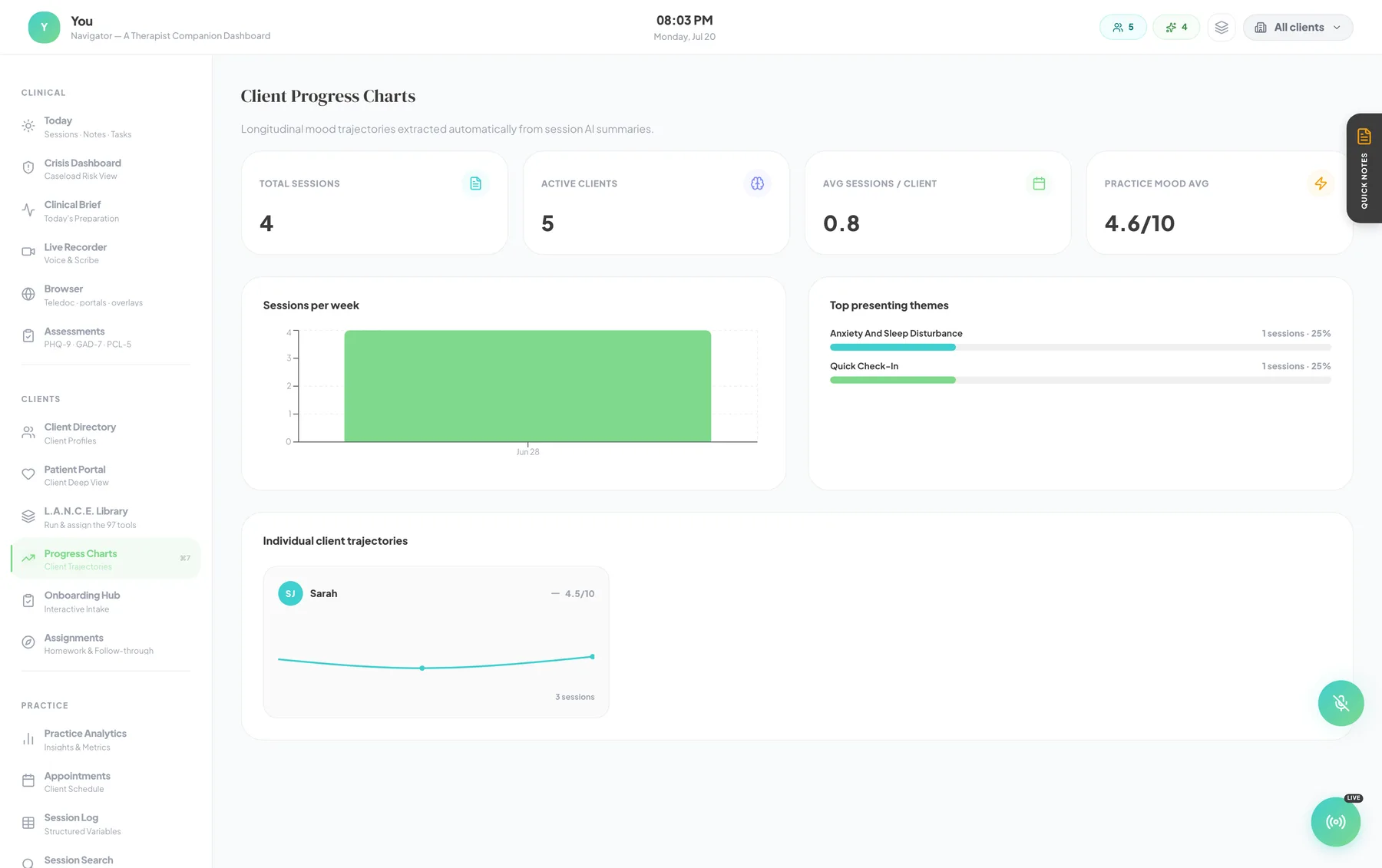
Progress: assessment scores over time and a fourteen-day mood line.
Progress. The shape of the fortnight — the run-up to this session, not a snapshot of this morning.

These are photographs of the running software, not drawings of what it might look like. It is the same build that sits open on my desk during a clinical day.

See every screen, and how the client side works →

Proven, not promised

You should not take my word for any of this.

A promise about privacy is worth very little. So the software checks itself, every time it is built, and refuses to ship if any of these stops being true.

Said here rather than found later

Two things I want you to know before you try it.

The honest exceptions

The demo is not on your machine. The showroom you can click into from this page runs on our server, so you can look around without installing anything. Everything in it is invented, and nothing in it can be filled in — every field is there to be read, not typed into. That is not a rule someone remembered to add; the server refuses to save anything at all. So there is no way for a real client to end up in it, including by accident.

It is new, and I am one person. The Lighthouse opens to clinicians on 21 August. I built it for my own practice, against my own way of working, and I am its first user — but it is young, and you would be early. In exchange for that: 30 days, full refund, no questions asked. If it does not earn its place in your week, write to ask@lancenabers.com and I send the money back.

I would rather tell you this now than have you discover it later. That is the same reason the software tells you where it is thinking.

Have a look, or just ask me.

You can open a full demo workspace right now — no card, no countdown. Or you can write to me and I will answer you myself.

Lance Nabers is a Licensed Professional Counselor with 25 years of practice and more than 25,000 client sessions.
He built this because he wanted his own notes where he could see them.